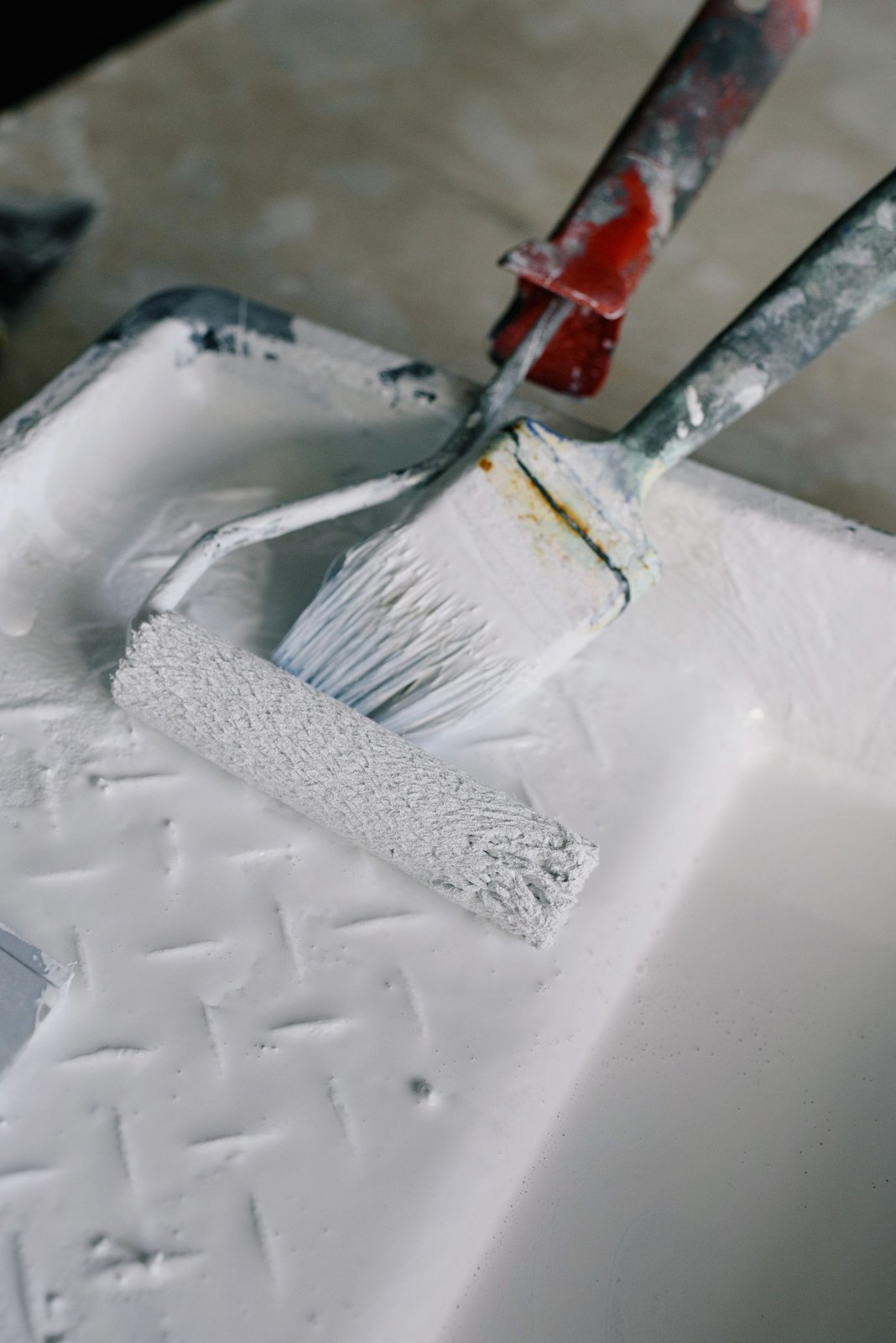
Primer, deck coatings and sealers count as paint, so take leftovers to a PaintCare drop-off or household hazardous waste site. Water-based caulk, spackle and joint compound can usually dry out and go in the trash. Mix leftover two-part epoxy in small batches so it hardens first. Anything labeled flammable goes to household hazardous waste.
Product-by-product guide
PaintCare takes many products besides wall paint, but not everything on the paint aisle. The second column is from PaintCare’s own lists. The third is the usual best option.
| Product | PaintCare takes it? | Usual best option |
|---|---|---|
| Primer, sealer, undercoater | Yes | PaintCare drop-off or household hazardous waste |
| Deck coatings and floor paint (including elastomeric) | Yes | PaintCare drop-off or household hazardous waste |
| Waterproofing sealers for concrete, masonry or wood | Yes, if not tar or bitumen-based | PaintCare drop-off or household hazardous waste |
| Metal coatings and rust preventatives | Yes | PaintCare drop-off or household hazardous waste |
| Roof patch, tar and asphalt products | No | Household hazardous waste |
| Other roof coatings | Not named; ask the site | Call a PaintCare site or your hazardous waste program |
| Chalk paint | Not named; ask the site | Call first; art and craft paints are excluded |
| Caulk | No | Water-based: dry it and trash it. Flammable: household hazardous waste |
| Spackle, joint compound, wood filler | Not on PaintCare’s lists | Water-based: dry it and trash it. Flammable: household hazardous waste |
| Epoxy and other two-part coatings | No | Mix small amounts, let them cure, then trash. Otherwise household hazardous waste |
| Glues and adhesives | No | Water-based: dry and trash. Solvent-based: household hazardous waste |
| Colorants, tints, additives | No | Household hazardous waste |
| Brushes, rollers, tape, drop cloths | No | Let paint dry on them, then trash |
Primer, deck coatings and sealers: treat them like paint
PaintCare’s accepted list includes primers, sealers and undercoaters; deck coatings and floor paints; stains and clear finishes; waterproofing sealers; metal coatings and rust preventatives; and field and lawn paints. In the 13 PaintCare areas, you can drop these off for free.
The usual PaintCare rules apply. The product must be in its original container with the printed label, the lid must be secure, and containers can be up to 5 gallons. Two-part versions, like two-part floor or garage coatings, are not accepted.
Outside PaintCare areas, take them to household hazardous waste. A water-based primer can be dried like latex paint where your area allows it. Oil-based primers and sealers should go to hazardous waste. For stain and varnish, see our separate guide.
Caulk, spackle, joint compound and wood filler
Read the label. That one step tells you what to do. Hennepin County, Minnesota, says water-based caulk, sheetrock mud and spackle can be dried out and put in the garbage. If the label says "soap and water cleanup," the product isn’t flammable and is safe for the garbage there. If the label says "flammable," it is petroleum-based and belongs at a hazardous waste drop-off.
Wood filler isn’t named in Hennepin’s rule, but the same label check works. Many fillers are water-based putties. Some are solvent-based. Your local program has the final say.
- Check the label for "soap and water cleanup" or "flammable."
- For water-based products, squeeze or scoop what’s left onto a piece of cardboard or into an open container.
- Let it harden all the way through. Thick blobs can take days.
- Put the hardened product and the empty tube or tub in the trash.
- Take anything labeled flammable to household hazardous waste, in its original container.
Epoxy and other two-part products
Epoxy comes as a resin and a hardener. Once they’re mixed in the right ratio and fully cured, epoxy maker WEST SYSTEM says the solid is non-hazardous and can be thrown away. So the best way to deal with small leftovers is to mix them and let them cure.
Be careful. Curing epoxy makes its own heat. WEST SYSTEM warns that a mixed pot can get hot enough to melt plastic, burn skin, give off harmful fumes or start a fire nearby. It says a 100-gram batch in a cup can reach 400°F.
- Mix only small amounts at a time, in the ratio on the label.
- Pour the mix into a wide, shallow container like an old roller tray so heat can escape.
- Set it outside or in a well-ventilated spot, away from anything that can burn, kids and pets.
- Wait until it’s hard and cool all the way through.
- Trash the cured solid. If you can’t mix it in the right ratio, take the resin and hardener to household hazardous waste instead.
Roof coatings and tar products
PaintCare doesn’t take roof patch and repair products, or anything asphalt, tar or bitumen-based. Take those to household hazardous waste.
Other roof coatings, like water-based elastomeric roof coatings, aren’t named on either PaintCare list. Call the drop-off site and read them the label before you go. If they say no, take it to household hazardous waste.
Chalk paint, craft paint and specialty finishes
PaintCare’s lists don’t mention chalk paint by name. They do exclude art and craft paints, and auto and marine paints. A site may or may not take it, so call first. If they won’t, use household hazardous waste, or dry small amounts of water-based chalk paint where your area allows drying paint.
Brushes, rollers, trays, tape and drop cloths
Brush out as much paint as you can before cleaning. In the Sacramento area, rinse water from cleaning latex paint off brushes and rollers can go down an indoor drain to the sanitary sewer. It must never go in a storm drain, on the ground or into a septic system. Your city may have its own rules.
Oil-based paint and stain need solvent for cleanup, not water. See our guide to paint thinner for what to do with used solvent.
Disposable brushes, worn rollers, used tape and paint-covered plastic drop cloths go in the trash once the paint on them is dry. Sacramento’s guide says to put dry paint cans and disposable brushes in the trash. Canvas drop cloths can be washed and used again.
What not to do
- Don’t pour any leftover product down a storm drain, onto the ground or into a septic system.
- Don’t combine different leftovers into one container. Sites can refuse products that aren’t in their original labeled container.
- Don’t put a pot of freshly mixed epoxy in the trash. Wait until it’s fully cured and cool.
- Don’t pile up rags used with oil-based products.
- Don’t assume a store that takes paint takes caulk, epoxy or spray cans. Ask.
Big cleanouts
A garage full of mixed painting products is easier if you sort first: PaintCare products, flammable products for hazardous waste, and water-based products you can dry and trash. If you’d rather not haul it yourself, Paint Again can pick up paint, primer, stain and varnish in sealed, labeled cans. It doesn’t collect thinners, solvents, spray cans or other chemicals yet. Contractors should see our contractor guide.
Checklist
- Sort leftovers into PaintCare products, flammable products and water-based products.
- Read each label for "soap and water cleanup" or "flammable."
- Take primer, deck coatings and sealers to a PaintCare drop-off or hazardous waste site.
- Dry water-based caulk, spackle and filler, then trash them.
- Cure small amounts of epoxy in a shallow tray before trashing.
- Dry oily rags flat outside and store them in a sealed metal can with water.
Common questions
Can I throw away caulk?
Water-based caulk can usually be dried and put in the trash. Hennepin County, Minnesota, for example, allows it if the label says "soap and water cleanup." Caulk labeled flammable goes to household hazardous waste.
Does PaintCare take primer?
Yes. Primers, sealers and undercoaters are on PaintCare’s accepted list, in the original labeled container up to 5 gallons.
How do you dispose of leftover epoxy resin?
Mix small amounts of resin and hardener in the right ratio, spread it in a shallow tray, and let it cure completely. Cured epoxy can go in the trash. If you can’t mix it, take it to household hazardous waste.
Can I throw away spackle or joint compound?
Usually, if it’s water-based. Let it dry hard first. Petroleum-based compounds labeled flammable go to hazardous waste.
Does PaintCare take roof coatings?
Not roof patch, tar or asphalt products. Other roof coatings aren’t named on PaintCare’s lists, so call the site and read them the label.
Can I take chalk paint to a paint recycling site?
Maybe. PaintCare doesn’t name chalk paint and excludes art and craft paint. Call the site before you go.
Can I wash paint brushes in the sink?
For latex paint, many places allow rinse water into an indoor drain that goes to the sewer. Never use a storm drain, the yard or a septic system. Oil-based paint needs solvent, not water.
Are paint rollers and painter’s tape recyclable?
Check your hauler, but plan on the trash. Sacramento’s guide, for example, puts dry disposable brushes in the trash. Let the paint dry on rollers and tape first.
Sources
Checked October 7, 2026. Your local drop-off site’s rules come first.
PaintCare: products we accept ↗PaintCare: frequently asked questions ↗Hennepin County Green Disposal Guide: joint compound ↗Hennepin County Green Disposal Guide: adhesives ↗WEST SYSTEM: environmental concerns (epoxy disposal) ↗WEST SYSTEM: uncontrolled cure ↗Sacramento Stormwater Quality Partnership: Painting Without Polluting ↗City of Bloomington, MN: oily rags safety tips ↗Sherwin-Williams: cleaning up after exterior stain ↗CalRecycle: paint ↗EPA: household hazardous waste ↗How we research →