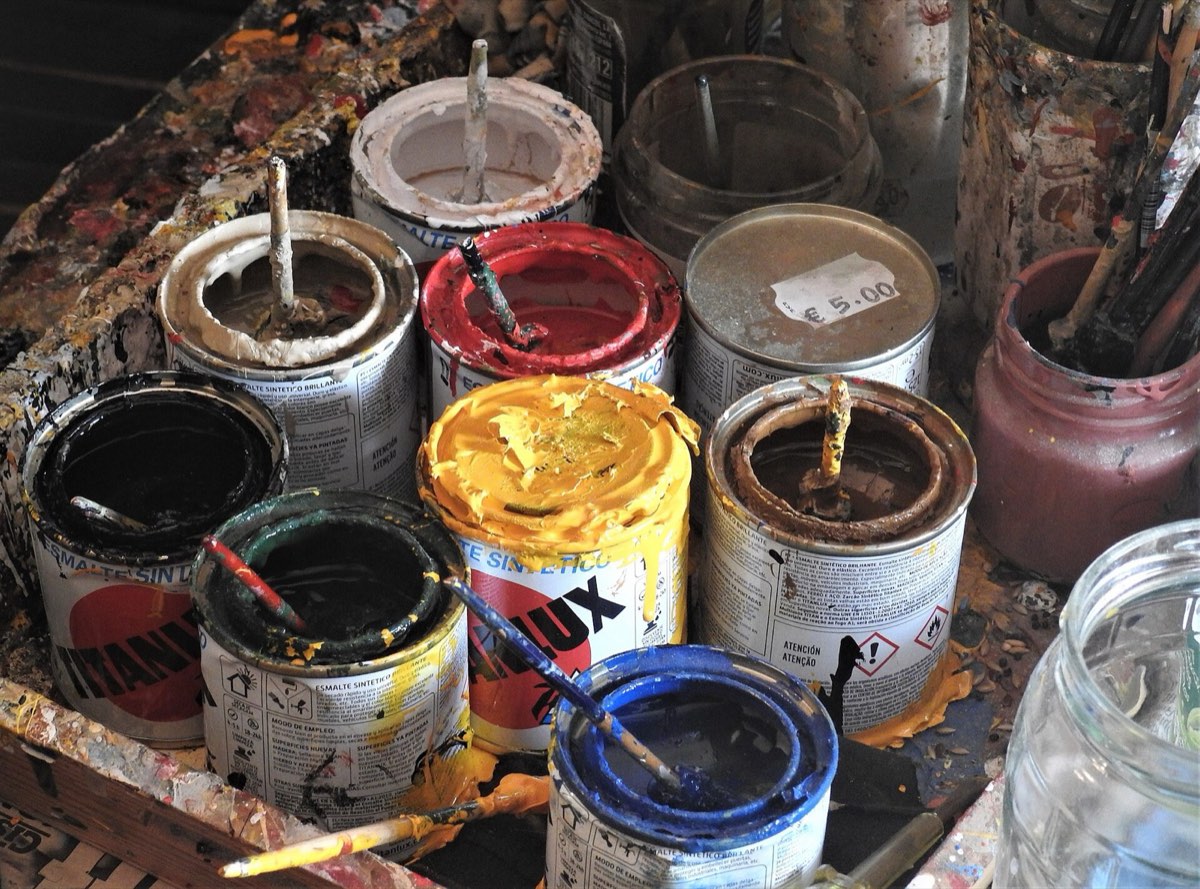

If the paint is still good, use it or give it away. If not, take it to a paint recycling drop-off or a household hazardous waste site. In most places, latex paint can go in the trash once it is completely dry. Oil-based paint, spray paint and thinner never go in the trash. California bans all paint from the trash.
Step 1: Figure out what kind of paint you have
The right answer depends on what is in the can. Read the label before you do anything else.
Latex paint is water-based. The label usually says to clean up with soap and water. Most leftover house paint is latex. PaintCare says about 80% of the paint it collects is latex. Acrylic paint is a kind of latex paint.
Oil-based paint is also called alkyd or enamel. The label says to clean up with mineral spirits or paint thinner. It often has a flammable warning. Stains, varnishes and polyurethanes are often oil-based too.
If the label is gone or you can’t tell, treat the paint as oil-based. That is the safe choice. Our guide to telling latex from oil-based paint has a few quick tests.
| What you have | Best place for it | Can it go in the trash? |
|---|---|---|
| Latex or acrylic house paint (liquid) | Paint recycling drop-off or household hazardous waste site | Only after it is fully dried, and never in California |
| Oil-based or alkyd paint | Paint recycling drop-off or household hazardous waste site | No |
| Stain, varnish, shellac, lacquer, one-part polyurethane | Paint recycling drop-off or household hazardous waste site | No, if oil-based |
| Primer, sealer, deck and floor paint | Paint recycling drop-off | Same rules as the paint type |
| Spray paint | Household hazardous waste site | Empty cans can in some places, like King County, WA |
| Paint thinner, mineral spirits, solvents | Household hazardous waste site | No |
| Craft, artist, auto or marine paint, two-part epoxy | Household hazardous waste site | Ask your local program |
| Empty or fully dried paint cans | Trash, or metal recycling if your town takes it | Usually yes, with the lid off |
Is the paint still good?
Good paint is worth keeping or giving away. Open the can and stir it well. Paint that has separated into layers is normal and usually mixes back together.
A thin skin on top is fine. Lift it out in one piece and strain the rest through a mesh strainer or old nylon stocking.
It’s time to let it go if it smells sour or rotten, has mold, stays lumpy after a good stir, or has turned thick like pudding. Our guide to how long paint lasts covers this in more depth.
Your options, from best to last resort
- Use it up. Add a second coat, paint a closet or use it as a base coat. This is free and nothing goes to waste.
- Give it away. Neighbors, schools, theater groups and community groups may want good paint in its original can. Some counties and stores run paint reuse shelves.
- Recycle it at a paint drop-off. In the 12 states and D.C. with a PaintCare program, paint stores and other sites take leftover paint for free.
- Take it to a household hazardous waste site or collection event. This is where spray paint, thinner and other chemicals go too.
- Dry out latex paint and put it in the trash, if your state and town allow it. Never do this with oil-based paint.
- Pay for a pickup if you have a lot of paint, no car, or no time. Check for free pickup programs first.
| Option | Cost | Takes | Watch out for |
|---|---|---|---|
| Use it or give it away | Free | Paint that is still good | Keep the label so people know what it is |
| PaintCare drop-off | Free | Latex, oil-based, stain, varnish, primer | No spray cans, thinners, or leaking or unlabeled cans |
| Hazardous waste site or event | Often free for residents; some charge | Paint plus spray cans, thinners and chemicals | Residency rules, appointments, yearly limits |
| Dry it and trash it | Cost of cat litter or hardener | Latex only | Not allowed in California; check local rules |
| Paid pickup | Varies | Whatever the company can legally take | Check free pickup programs first |
How to recycle paint for free
PaintCare is a nonprofit set up by paint makers. It runs free paint recycling in California, Colorado, Connecticut, Illinois, Maine, Maryland, Minnesota, New York, Oregon, Rhode Island, Vermont, Washington and the District of Columbia.
You already paid for it. A small fee is added to the price of new paint in those places. PaintCare says it ranges from 30 cents to $2.75, depending on the can size and the state. There is no charge when you drop paint off.
Drop-off sites include paint and hardware stores, county hazardous waste sites and some transfer stations. Every PaintCare site takes at least 5 gallons per visit, and some take more. Not every store in a chain takes paint, so use the locator and call the store first.
PaintCare sites take house paint, primer, stain, sealer, shellac, lacquer, varnish and one-part urethane. The paint must be in its original can, with the maker’s label and a tight lid. Sites turn away spray cans and leaking, unlabeled or empty containers.
What to bring to a drop-off
- Paint in its original can, with the label readable and the lid on tight.
- A list of what you have and about how much. Count each can by its size, not by how much is left.
- Proof that you live there, like a driver’s license or utility bill, if it’s a county site. Many county sites are for residents only.
- Spray cans, thinners and unlabeled cans in a separate box. A paint store will send them home with you.
- A backup plan. Sites can be full, closed for the day or out of space for paint.
How to dry out latex paint for the trash
Drying is the last resort for latex paint, not the first choice. Do it only where your state and town allow it. California does not. CalRecycle says not to dry paint on purpose to throw it away.
- Work outside or in a garage with good air flow. Keep kids and pets away.
- For less than an inch of paint, take the lid off and let it air dry. Stir now and then to speed it up.
- For more than an inch, stir in cat litter or a store-bought paint hardener until the paint is thick and won’t pour.
- Wait until it is solid all the way through. Poke it. If it is still wet in the middle, wait longer.
- Put the can in the trash with the lid off, so the trash collector can see it is dry.


Oil-based paint, stain and varnish
Oil-based paint burns. Many oil-based products have a flash point below 140 °F, which is the federal test for an ignitable waste. That is why oil-based paint should never go in the trash, down a drain or on the ground.
Take it to a PaintCare drop-off or a household hazardous waste site. Don’t try to dry it out for the trash. Vermont’s environment department calls oil-based paint hazardous and flammable and says never to throw it in the trash. New York’s Onondaga County says the same.
Collected oil-based paint is mostly burned as fuel. PaintCare says a small share is recycled into new paint.
Spray paint, thinner and other products
PaintCare sites do not take spray paint, paint thinner, mineral spirits or other solvents. They also don’t take craft or artist paint, auto or marine paint, two-part epoxies, caulk, glue or roof tar.
Take these to your household hazardous waste site or event. Keep them in their original containers. Never mix products together.
Spray paint: full or partly full cans go to hazardous waste. In King County, WA, empty spray cans can go in the garbage. Rules on empty cans differ, so check yours.
Paint thinner: if you cleaned brushes with it, let the dirty thinner sit in a closed jar until the paint settles. Pour off the clear thinner to use again. King County says to wrap the leftover sludge in plastic for the trash and take the liquid to hazardous waste.
Vermont passed a law in 2025 to add spray paint and other coating products to its PaintCare program. As of October 2026, the new plan was still being reviewed, so don’t bring spray cans to Vermont paint stores yet.
Never pour paint down the drain or on the ground
EPA warns against pouring household hazardous products down the drain, on the ground or into storm drains. Storm drains often flow straight to streams. Paint can also harm septic systems, which rely on living bacteria.
There is one small exception. If your home is on city sewer, many cities let you rinse latex paint brushes in a sink. Wipe off as much paint as you can first. Never do this on a septic system, and never with oil-based paint or thinner. Our guide to pouring paint down the drain has the details.
How the rules differ by state
Federal law leaves household paint to states and towns. That is why your neighbor in another county may have different rules. Here is what state and local agencies say in some of the places we cover.
| Place | Liquid paint in trash? | Dried latex in trash? | Good to know |
|---|---|---|---|
| California | No | No | CalRecycle presumes latex paint is hazardous waste. All paint must be recycled or taken to a proper site. |
| Vermont | No | Ask your waste district | Oil-based paint never goes in the trash. Spray paint is being added to PaintCare, but not yet. |
| New York (Onondaga County) | No | Yes, lid off | Liquid paint in the trash can lead to fines, the county says. |
| Minnesota (Hennepin County) | Not advised | Yes, lid off | County sites take latex paint free, up to three 5-gallon pails a year. |
| Washington (King County) | No | Yes, lid off | Under an inch can air dry. More needs cat litter or hardener. |
| Illinois | Not advised | Check local rules | Free PaintCare drop-off started December 2025. PaintCare sites don’t take spray cans. |
| Colorado | Not advised | Check local rules | PaintCare offers free door-to-door pickup for 10+ gallons in some areas. |
| Connecticut | Not advised | Check local rules | Town hazardous waste days take oil-based paint. Only some take latex. |
| Maryland | Not advised | Check local rules | Free PaintCare drop-off started April 2026. |
| States without PaintCare | Check local rules | Usually yes | Use your county’s hazardous waste site or events for oil-based paint. |
Is paint hazardous waste?
It depends on the paint and who throws it away. Under federal law, waste from a home is not regulated as hazardous waste. EPA still calls leftover paint household hazardous waste because it can catch fire or harm people and water. States and towns set the rules for it.
Oil-based paint, thinners and spray paint are the real hazards. They burn easily and give off fumes. Latex paint is much safer and is usually not hazardous waste. California is the big exception. CalRecycle says latex paint waste is presumed hazardous there.
For businesses the rules are stricter, because the household exclusion doesn’t apply. Our guide to whether paint is hazardous waste explains the details.
Tricky cases
- Frozen latex paint: let it thaw at room temperature and stir well. If it stays lumpy or grainy, treat it as waste.
- Moldy or sour-smelling paint: don’t use it. Recycle it or dry it out where allowed.
- Rusted or leaking cans: drop-off sites turn away leaking containers. Set the can in a bucket or larger container and call your hazardous waste site before you go.
- No label: PaintCare sites won’t take it. A household hazardous waste site can deal with unknown products.
- Very old paint: EPA says lead paint for homes was banned in 1978. Paint older than that may contain lead, so don’t sand, scrape or burn it. Take the cans to hazardous waste.
- A lot of paint: PaintCare offers free pickup for 100 gallons or more. Count by can size, not by how much is left in each can.
- Business paint: businesses can drop off any amount of latex paint a site will take. Oil-based paint from a business is limited to very small businesses, except in Illinois.
- No car: PaintCare offers free pickup for 10+ gallons in parts of Colorado, New York and D.C. Elsewhere, a paid pickup like ours may be the easiest option.
Stay safe while you sort and haul
- Keep paint in its original can with the label on. EPA says never remove labels.
- Never mix different products together, even to save space.
- Keep oil-based paint, thinner and spray cans away from flames, pilot lights and heat.
- Hammer lids shut. Pack cans upright in a box or bin so they can’t tip over.
- Put the box in the trunk or truck bed, not on a seat.
- Drive straight to the drop-off. Don’t leave cans in a hot car.
What it costs
In PaintCare states, drop-off is free because the fee was in the price of the paint. Many county hazardous waste sites are free for residents, but some charge fees or limit how much you can bring.
Drying latex paint costs only the cat litter or hardener. Outside PaintCare states, some programs charge for paint, so check your county’s site.
Paid pickup costs more than doing it yourself. It makes sense when you have a lot of paint, no car or no time. Our pickup page shows prices up front.
Quick guide: if you have this, do this
- A few cans of good paint: use it up or give it away.
- Leftover house paint in a PaintCare state: take it to a free PaintCare drop-off.
- A little latex paint outside California: dry it out and put the can in the trash, lid off.
- Oil-based paint, stain or varnish: PaintCare drop-off or hazardous waste. Never the trash.
- Spray paint, thinner, solvents or craft paint: household hazardous waste.
- A can with no label: household hazardous waste.
- Paint from before 1978: household hazardous waste. Don’t sand or burn it.
- 100 gallons or more: request a free PaintCare large volume pickup.
- Lots of paint and no car: check for free door-to-door pickup, then consider a paid pickup.
Checklist
- Read each label and sort latex from oil-based paint.
- Set aside good paint to use or give away.
- Pull out spray cans, thinners and unlabeled cans for hazardous waste.
- Find a drop-off site and call to check hours and limits.
- Hammer lids shut and pack cans upright in a box.
- Dry out small amounts of latex only if your area allows it.
Common questions
Can you throw away paint?
Dried latex paint can go in the trash in most places, with the lid off. Liquid paint cannot. Oil-based paint never goes in the trash. In California, no paint goes in the trash, even dried.
What do you do with old paint you don’t need?
Use it or give it away if it’s still good. Otherwise, take it to a paint recycling drop-off or a household hazardous waste site. In PaintCare states, drop-off is free.
Is it free to recycle paint?
Yes, in the 12 states and D.C. with PaintCare. The cost is built into the price of new paint. Elsewhere, county hazardous waste sites are often free for residents, but some charge.
How long does it take latex paint to dry out?
It depends on how much paint is left, the weather and the air flow. A thin layer can dry in a day or two. A full can can take much longer, so mix in cat litter or a paint hardener.
Can I put dried paint cans in the recycling bin?
Only if your town’s recycling takes metal paint cans. Many towns ask you to put empty, dried cans in the trash instead. Check your town’s recycling list.
Do Home Depot or Lowe’s take old paint?
Some stores do in PaintCare states, but it’s store by store. Search PaintCare’s locator to see which stores near you are listed, then call before you go.
Can I put paint in a dumpster?
Don’t put liquid paint, oil-based paint or spray cans in a rented dumpster. Most dumpster companies have a list of banned items. Ask before you toss even dried latex.
Can I burn old paint or leave it at the curb?
No. Burning paint releases toxic fumes, and old paint may contain lead. Don’t leave cans at the curb unless your town runs a paint pickup. Liquid paint in the trash can lead to fines in some places, like Onondaga County, NY.
I live in an apartment with no garage. What can I do?
Skip drying paint indoors. Take it to a drop-off site in a box in your trunk, or ask your building manager if the property has a pickup. A paid pickup also works if you have no car.
What happens to paint I drop off?
PaintCare says most latex paint is made into recycled paint or other products. Oil-based paint is mostly burned as fuel. Paint that can’t be used may be landfilled.
Sources
Checked October 7, 2026. Your local drop-off site’s rules come first.
PaintCare: frequently asked questions ↗PaintCare: products we accept ↗PaintCare: drop-off site locator ↗PaintCare: business limits ↗EPA: household hazardous waste (HHW) ↗EPA: protect your family from sources of lead ↗40 CFR 261.21: ignitable waste (flash point below 140 °F) ↗CalRecycle: paint ↗Vermont DEC: proper recycling and disposal of paint ↗OCRRA (Onondaga County, NY): paint and paint products ↗Hennepin County, MN: latex paint and cans ↗King County, WA: latex, water-based or acrylic paint ↗King County, WA: spray paint ↗King County, WA: paint thinner ↗NFPA safety tip sheet: oily rags (City of Bloomington, MN copy) ↗How we research →