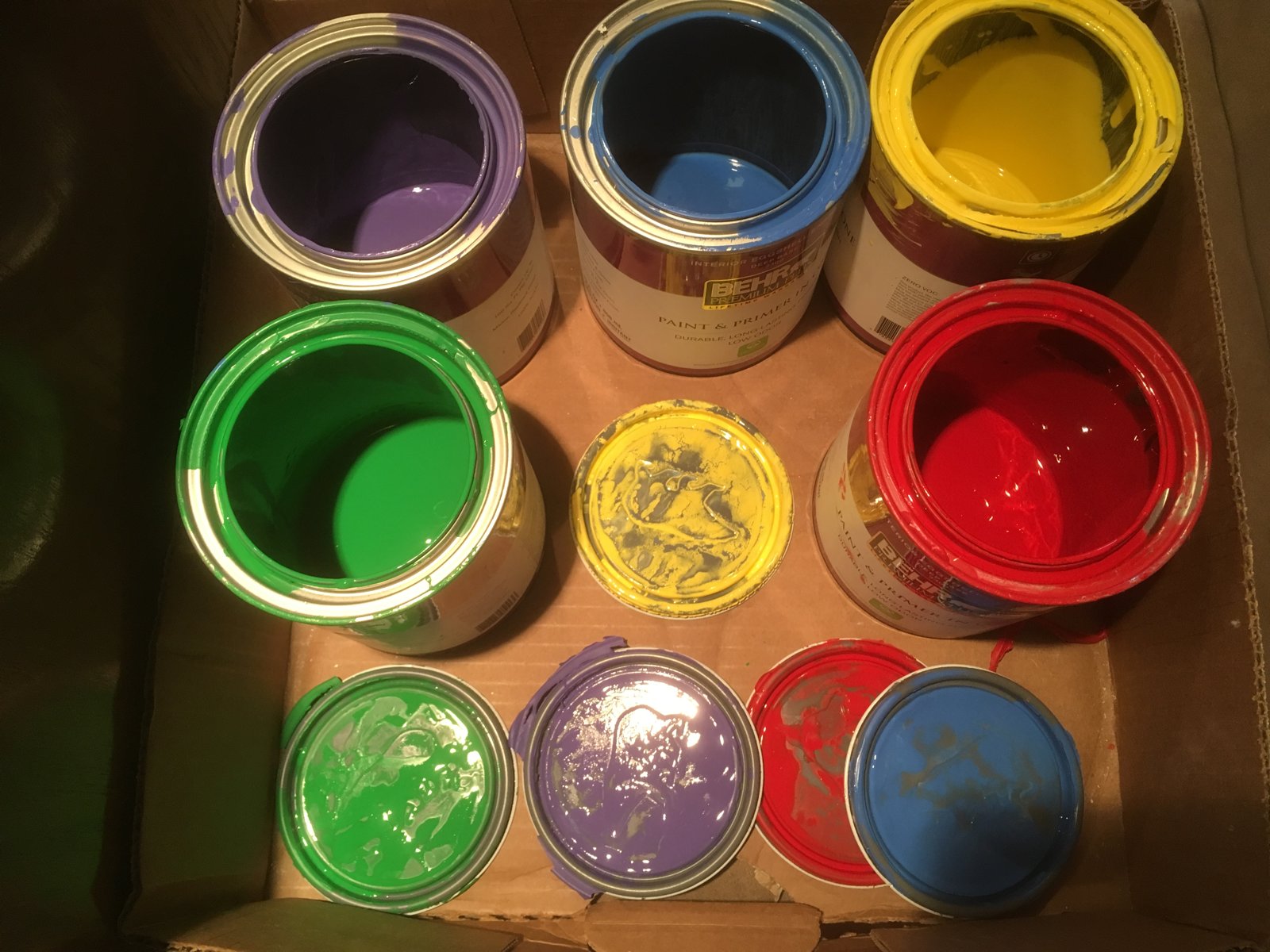

A gallon of paint covers about 350 to 400 square feet per coat on smooth walls. To find how much you need, measure the wall area, subtract doors and windows, multiply by the number of coats and divide by 350. A 12-by-12-foot room with 8-foot walls needs about 2 gallons for two coats.
How much does a gallon of paint cover?
Most paint makers put one gallon at 300 to 400 square feet for one coat. Sherwin-Williams says 350 to 400. Behr’s data sheet for its PRO interior paint says 300 to 400, depending on texture and how porous the surface is. Glidden says up to 400 on primed, smooth surfaces.
PaintCare suggests using 350 square feet per gallon when you don’t know the exact number. That’s what the examples on this page use. Your can’s label lists the real figure for that product, so check it if you can.
| What you buy | About how much it covers (one coat) | Source |
|---|---|---|
| 1 gallon of wall paint | 350 to 400 sq ft on smooth walls | Sherwin-Williams; Behr lists 300 to 400 |
| 1 quart of paint | About 100 sq ft | Sherwin-Williams |
| 1 gallon of primer | 200 to 300 sq ft | Sherwin-Williams |
| 4.5 oz spray can | About 7 sq ft | Sherwin-Williams |
| 11 to 12 oz spray can | About 20 sq ft | Sherwin-Williams |
| 16 oz spray can | About 30 sq ft | Sherwin-Williams |
| 5-gallon bucket | About 1,750 to 2,000 sq ft (5 times a gallon) | Math from the gallon figure |
The paint formula
Here’s how to work it out with a tape measure and a phone calculator.
- Measure around the room. Add the length of every wall to get the distance around the room.
- Multiply that by the wall height. This is your total wall area in square feet.
- Subtract doors and windows. Measure each one and multiply its width by its height. A 3-by-7-foot door is 21 square feet. A 3-by-5-foot window is 15 square feet.
- Multiply by the number of coats. Most jobs need two.
- Divide by 350, or by the coverage number on your can.
- Round up to the next quart or gallon.
How many coats do you need?
Plan on two coats for most rooms. Benjamin Moore’s paint calculator assumes two coats. You may need more, or extra primer, in these cases:
- Big color change. PaintCare says going from dark to light, or light to dark, can take three or four coats. A tinted primer can cut that down.
- Bare or patched drywall, or new wood. Unprimed surfaces soak up more paint. Prime first.
- Rough or textured surfaces. PaintCare says you may need up to 50 percent more paint for rough textures like stucco, popcorn ceilings or rough siding.
- Glossy finishes. PaintCare says flat paint usually covers better, while semi-gloss and gloss can need more.
- Spraying. Behr’s coverage numbers don’t include paint lost to overspray, so plan for extra if you use a sprayer.
- Same color, good condition. If you’re freshening up the same color, one coat may be enough. Glidden’s calculator asks whether you’re changing colors and notes that drastic color changes usually need a second coat.
How much paint for a bedroom or living room?
PaintCare gives its own simple example: a 10-by-10-foot room with 10-foot ceilings has about 400 square feet of wall, so it takes about one gallon per coat at 400 square feet per gallon.
| Room | Wall area after doors and windows | Two coats | Paint to buy |
|---|---|---|---|
| 10 × 10 ft bedroom, 1 door, 1 window | 320 − 36 = 284 sq ft | 568 sq ft | 2 gallons |
| 12 × 12 ft bedroom, 1 door, 2 windows | 384 − 51 = 333 sq ft | 666 sq ft | 2 gallons |
| 12 × 15 ft bedroom, 1 door, 2 windows | 432 − 51 = 381 sq ft | 762 sq ft | 2 gallons + 1 quart, or 3 gallons if walls are textured |
| 14 × 18 ft living room, 9 ft walls, 2 doors, 3 windows | 576 − 87 = 489 sq ft | 978 sq ft | 3 gallons |
| Small bathroom, 5 × 8 ft, 1 door, no window | 208 − 21 = 187 sq ft (less after the tub, tile and mirror) | 374 sq ft or less | 1 gallon |
| One accent wall, 12 ft wide × 8 ft | 96 sq ft | 192 sq ft | 2 quarts |
How much paint for a ceiling?
A flat ceiling’s area is just the room’s length times its width. A 12-by-12-foot ceiling is 144 square feet. Two coats come to 288 square feet, which fits in one gallon.
Paint calculators often leave ceilings out. Benjamin Moore says its calculator does not include the ceiling, so add it yourself.
Popcorn and other textured ceilings drink more paint. Use PaintCare’s rule of up to 50 percent extra for rough textures. Check the ceiling paint’s label too, since coverage varies by product.
How much paint for trim and doors?
Trim takes less paint than people expect. Work it out in square feet, the same way as walls.
Baseboards: multiply the length in feet by the height. In a 12-by-12-foot room, about 48 feet of 4-inch baseboard (one-third of a foot) is 16 square feet per coat.
Doors: a 3-by-7-foot door is 21 square feet per side. Two sides and two coats come to 84 square feet.
Window and door casing: measure the length of the trim and multiply by its width. It adds up to a few square feet per opening.
Since Sherwin-Williams puts a quart at about 100 square feet, one quart often covers the baseboards and a door in a single room. For a whole house of trim and doors, add up each room and buy gallons.
How much paint for a house exterior?
Measure each side of the house. Multiply the width by the height up to the roof line. For the triangle-shaped end walls under a peaked roof (gables), multiply the width by the height of the triangle and divide by 2. Subtract big openings like garage doors, then add everything up.
Example: a one-story house that is 40 by 30 feet with 10-foot walls has 1,400 square feet of wall. Two gables 30 feet wide and 8 feet tall add 240 square feet. Take off about 200 square feet for doors and windows. That leaves 1,440 square feet.
For two coats, that’s 2,880 square feet. At 350 square feet per gallon, that’s about 8.2 gallons on smooth siding, so buy 9. Rough wood, stucco or brick can take up to 50 percent more, according to PaintCare. That could push it to 13 gallons.
With a range that wide, buy enough for the first coat plus a little extra. Then see how far it went before you buy the rest. Use the exterior paint’s label for its own coverage on rough surfaces.
Using a paint calculator
Paint brands have free online calculators. Benjamin Moore’s asks for room size and the number of doors and windows, and assumes two coats. Glidden’s asks the same, plus whether you’re making a big color change, and assumes up to 400 square feet per gallon.
Both are rough estimates. Benjamin Moore says its results are not meant to be more than a rough guide, and that what you need depends on things like how you apply the paint. Sherwin-Williams suggests checking with a store employee if you want to confirm. PaintCare recommends bringing your measurements to the paint store and asking.
How to avoid leftover paint
Extra paint ends up on a garage shelf for years. A little planning keeps leftovers small.
- Measure, don’t guess. Most leftovers come from rounding up too far.
- Mix sizes. If you need 2.3 gallons, buy 2 gallons and a quart instead of 3 gallons.
- Buy the last can later. Buy enough for most of the job, see how the first coat goes, then go back for the rest.
- Use a tinted primer for big color changes so you need fewer coats of top coat. PaintCare suggests this.
- Keep only a small amount for touch-ups. A quart or less is plenty for most rooms.
- If you’re using several gallons of one color, mix them together in a larger bucket so the color stays even across the walls.
What to do with the paint you have left
Close the can well so it keeps. Clean the rim, lay plastic wrap over the opening and tap the lid down. Write the room and date on the lid.
PaintCare has ideas for using leftovers. A gallon or more can work as primer on another project. Less than a gallon can do a small room or an accent wall. A quart can cover a window frame or two or the inside of a bookshelf.
If you won’t use it, give it to someone who will, or drop it off for recycling. In PaintCare states, drop-off is free at participating sites.
Checklist
- Measure the length of each wall and the wall height.
- Subtract each door and window.
- Multiply by two coats, or more for a big color change.
- Divide by 350, or the coverage on your can, and round up.
- Add ceilings, trim and doors separately.
- Buy a mix of gallons and quarts so you don’t overbuy.
Common questions
How many gallons of paint for a 12x12 room?
About 2 gallons for two coats on the walls, if the walls are 8 feet tall with one door and two windows. Add 1 gallon if you’re also doing the ceiling.
How many square feet does a gallon of paint cover?
About 350 to 400 square feet per coat on smooth, primed walls, according to Sherwin-Williams. Behr lists 300 to 400. Rough surfaces can take up to 50 percent more paint.
Is one gallon of paint enough for a room?
For one coat in a small room, often yes. For two coats, most bedrooms need about 2 gallons. Sherwin-Williams says having a little more than a gallon on hand may be best.
Do I really need two coats?
Usually. Two coats give an even color and finish, and most calculators assume two. One coat can work if you’re putting the same color back on clean, sound walls.
How much primer do I need?
Sherwin-Williams says a gallon of primer covers about 200 to 300 square feet. Most jobs need one coat of primer, so divide your wall area by 250.
Is a quart enough to paint a door?
Yes, for most doors. A 3-by-7-foot door is 21 square feet per side. Two sides with two coats is 84 square feet, and a quart covers about 100.
How much spray paint do I need?
Sherwin-Williams says an 11 or 12 ounce can covers about 20 square feet. Measure the surface and add a can for a second coat.
Should I buy extra paint for touch-ups?
You don’t need to buy extra. What’s left in the last can is usually enough. Save a quart or less, label it and store it well.
Sources
Checked October 7, 2026. Your local drop-off site’s rules come first.
PaintCare: buy right (how much paint to buy) ↗PaintCare: use it up ↗PaintCare: paint smarter ↗Sherwin-Williams: paint calculator and coverage FAQs ↗Benjamin Moore: paint calculator ↗Glidden: paint calculator ↗Behr PRO Interior Eggshell technical data sheet (coverage) ↗Benjamin Moore: storing leftover paint ↗How we research →